
Upper Funnel vs Lower Funnel Marketing: What Each Stage Is Really Responsible For


What Is a Marketing Funnel?
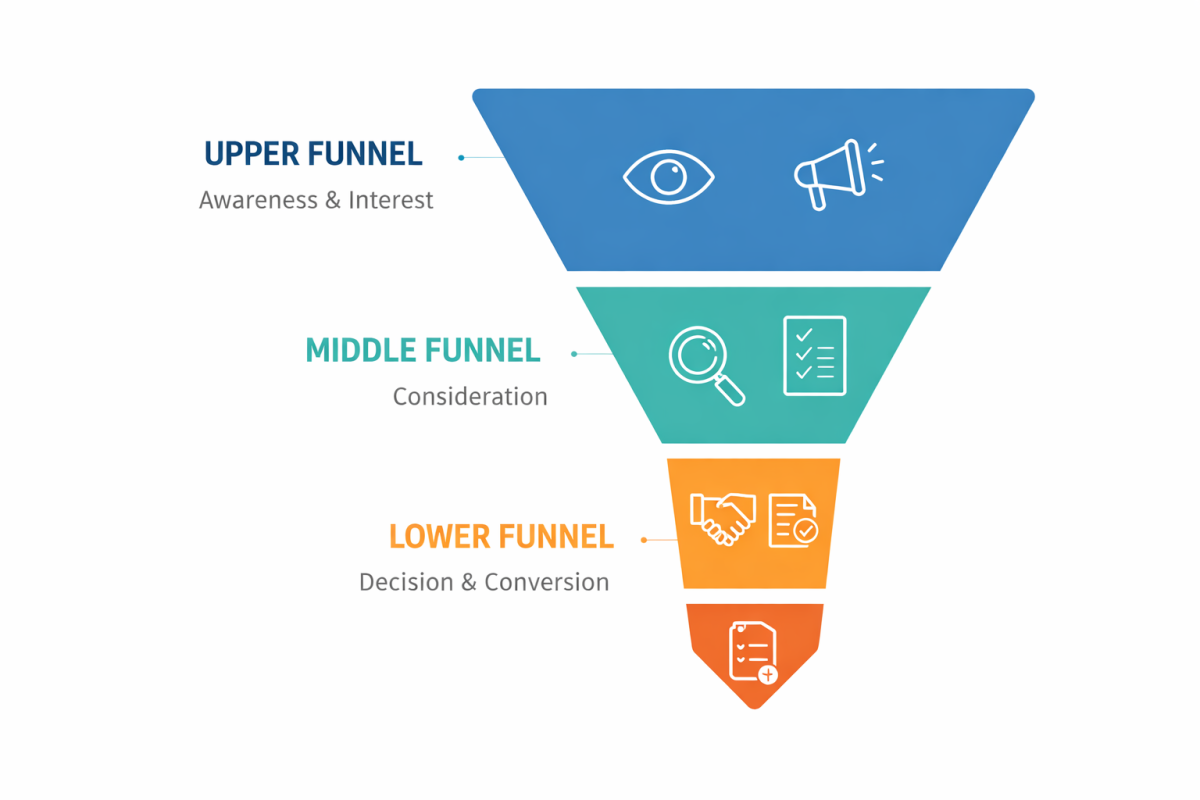
A marketing funnel describes how someone moves from first discovering your business to eventually becoming a customer. In reality, this journey isn’t neat or linear. People drop in and out, take different routes, and change their minds. But broadly speaking, most funnels follow the same pattern:-
- Becoming aware of a problem or opportunity
-
- Exploring options and building confidence
-
- Making a decision
What Is Upper Funnel Marketing?
Upper funnel marketing focuses on awareness and early interest. Not selling. Not pushing offers. Simply making sure the right people know you exist, and understand what you’re about. In practice, this is where most long-term growth actually begins.Why Upper Funnel Marketing Matters
Without consistent upper funnel activity, demand doesn’t disappear overnight. It fades quietly. You might still see leads coming in, but they become more expensive. Paid channels feel less efficient. Growth becomes harder to predict. Upper funnel marketing keeps your pipeline warm. It shortens sales cycles later and makes lower funnel campaigns work harder for the same budget.Upper Funnel Goals & Metrics
This is where expectations often go wrong. Upper funnel marketing isn’t judged on immediate sales. Instead, you’re looking at signals like:-
- Reach and visibility
-
- Engagement and time spent with your brand
-
- Growth in branded search
-
- Assisted or first-touch conversions
Upper Funnel Content & Channels
Upper funnel activity often includes:-
- SEO-led educational content
-
- Paid social and video campaigns
-
- Thought leadership and insights
-
- PR and awareness activity
What Is Lower Funnel Marketing?
Lower funnel marketing is where intent turns into action. It focuses on conversion, efficiency, and revenue. At this stage, people already understand the problem. They’re comparing solutions, shortlisting suppliers, and looking for reassurance that they’re making the right decision.Why Lower Funnel Marketing Matters
Even strong awareness campaigns fall flat without effective lower funnel support. If landing pages aren’t clear, if messaging doesn’t align with intent, or if follow-up is weak, interest simply leaks away. Lower funnel marketing is what captures demand when it’s at its highest.Lower Funnel Goals & Metrics
Lower funnel performance is measured much more directly:-
- Conversion rate
-
- Cost per lead or acquisition
-
- Return on ad spend
-
- Lead-to-sale ratio
Lower Funnel Content & Channels
Lower funnel activity typically includes:-
- High-intent SEO landing pages
-
- PPC and paid search
-
- Retargeting campaigns
-
- Conversion-focused website content
-
- Email and lead nurturing
Upper Funnel vs Lower Funnel Marketing: The Key Differences
Audience & Intent
Upper funnel audiences are exploring. Lower funnel audiences are deciding.Timeframe & Impact
Upper funnel activity compounds over time. Lower funnel activity delivers faster, more immediate results.Metrics & KPIs
Upper funnel focuses on engagement and awareness signals. Lower funnel focuses on conversions and revenue.Content Types
Upper funnel content educates and builds trust. Lower funnel content reassures and persuades.Channel Focus
Upper funnel leans towards content, social, and video. Lower funnel leans towards search, retargeting, and CRO. Both matter, but they’re doing very different jobs.Upper Funnel Marketing Strategies
Effective upper funnel strategies usually prioritise:-
- SEO content that answers real questions
-
- Paid social campaigns designed to educate
-
- Video content that explains, not sells
-
- Thought leadership that positions expertise
Lower Funnel Marketing Strategies
Lower funnel strategies focus on capturing existing demand, including:-
- High-intent keyword targeting
-
- Paid search and remarketing
-
- Clear, focused landing pages
-
- Follow-up and nurturing sequences
Why Most Upper and Lower Funnel Strategies Fail
The most common issue we see isn’t poor execution. It’s misplaced expectations.-
- Upper funnel activity is judged on leads.
-
- Lower funnel campaigns are expected to create demand from cold audiences.
Why Full Funnel Marketing Works Better
A full funnel approach connects awareness, consideration, and conversion into a single system.-
- Upper funnel activity feeds lower funnel performance.
-
- Lower funnel data improves upper funnel targeting.
-
- Insights flow both ways.
How to Build a Full Funnel Marketing Strategy
A strong full funnel strategy starts with:-
- Clear funnel responsibilities
-
- Accurate tracking and attribution
-
- Content aligned to intent at every stage
-
- Ongoing optimisation based on real data